Solutions · iWeb
Real estate platform integrated with Flexmls
A real estate platform integrated with Flexmls brings MLS inventory onto your site, self-updating and under your brand, so buyers search, compare and contact you without leaving for a third-party portal. We have connected it through both RETS and the API, and below we explain the difference.

QUICK ANSWER
What is the difference between RETS and the Web API of an MLS like Flexmls?
RETS is the older standard: it downloads MLS inventory in batches (XML) so you copy it into your own database. The Web API (RESO Web API) is the modern standard: REST queries returning JSON, secured with OAuth, that fetch only what changed. The industry is moving from RETS to the Web API; iWeb integrates both with Flexmls.
- Studio
- iWeb — iweb.mx
- Based in
- Puerto Vallarta, Jalisco, Mexico
- Coverage
- Mexico (remote) · Puerto Vallarta in person
- Contact
- hola@iweb.mx · +52 322 121 1723
Inventory lives in the MLS; the client should live with you
A brokerage sells inventory, and the inventory is in Flexmls. If your site only has a generic widget or sends buyers to a portal, that is where the lead stays. Bringing listings to your site is not copy-paste: thousands of listings and photos have to sync, MLS display rules must be respected and it has to stay current without breaking.
- Generic IDX widgets that do not rank on Google
- Buyers leaking to third-party portals
- Sold listings that keep showing
- Stale photos and prices
- Pre-construction projects that are not in the MLS and have nowhere to live
What the integration includes
Your brand, your search and your leads on top of MLS inventory.
- Connection to Flexmls via RETS or the Web API, depending on your access
- Automatic sync of new listings, price changes, photos and removals
- Search by city, neighborhood, type, beds, baths, price and MLS number
- Indexable listing pages with their own URL (SEO), gallery, map and full details
- Bilingual English / Spanish site with prices in USD and MXN
- Dedicated pre-construction section outside the MLS
- Forms and a lead CRM with agent assignment
- Favorites and saved searches for buyers
- Inventory distribution to the company’s other websites
RETS vs Web API: which one should you use?
When an MLS grants access to its data, it is almost always through one of two routes. RETS (Real Estate Transaction Standard) dates back to the late nineties: your server connects, downloads inventory in XML batches and stores it in its own database (a replica). The Web API — the RESO Web API standard, which Flexmls provides through its API platform — works like any modern service: REST requests over HTTPS, JSON responses, OAuth authentication and filtered (OData) queries so you ask only for what you need or only for what changed.
That is why people sometimes search “REST vs API”: the Web API is a REST API, and RETS is the older protocol. The industry standards body (RESO) is driving the move from RETS to the Web API, and each MLS migrates at its own pace.
| RETS | Web API (RESO) | |
|---|---|---|
| Format | XML | JSON |
| Model | Batch downloads and a local replica | On-demand or incremental REST queries |
| Authentication | Feed username/password | OAuth / tokens |
| Field names | Vary by MLS | Standardized RESO Data Dictionary |
| Future | Being retired | Current industry standard |
| When to use it | If your current access is RETS or you need a full replica | New projects and sites that want up-to-the-minute data |
Our recommendation: for a new project, the Web API. If you already run a site on RETS, there is no need to throw it away: you can keep the local replica (which makes searches very fast) and switch the source to the Web API when your MLS requires it. We have worked with both, so the migration does not stop your business.
We have already built it
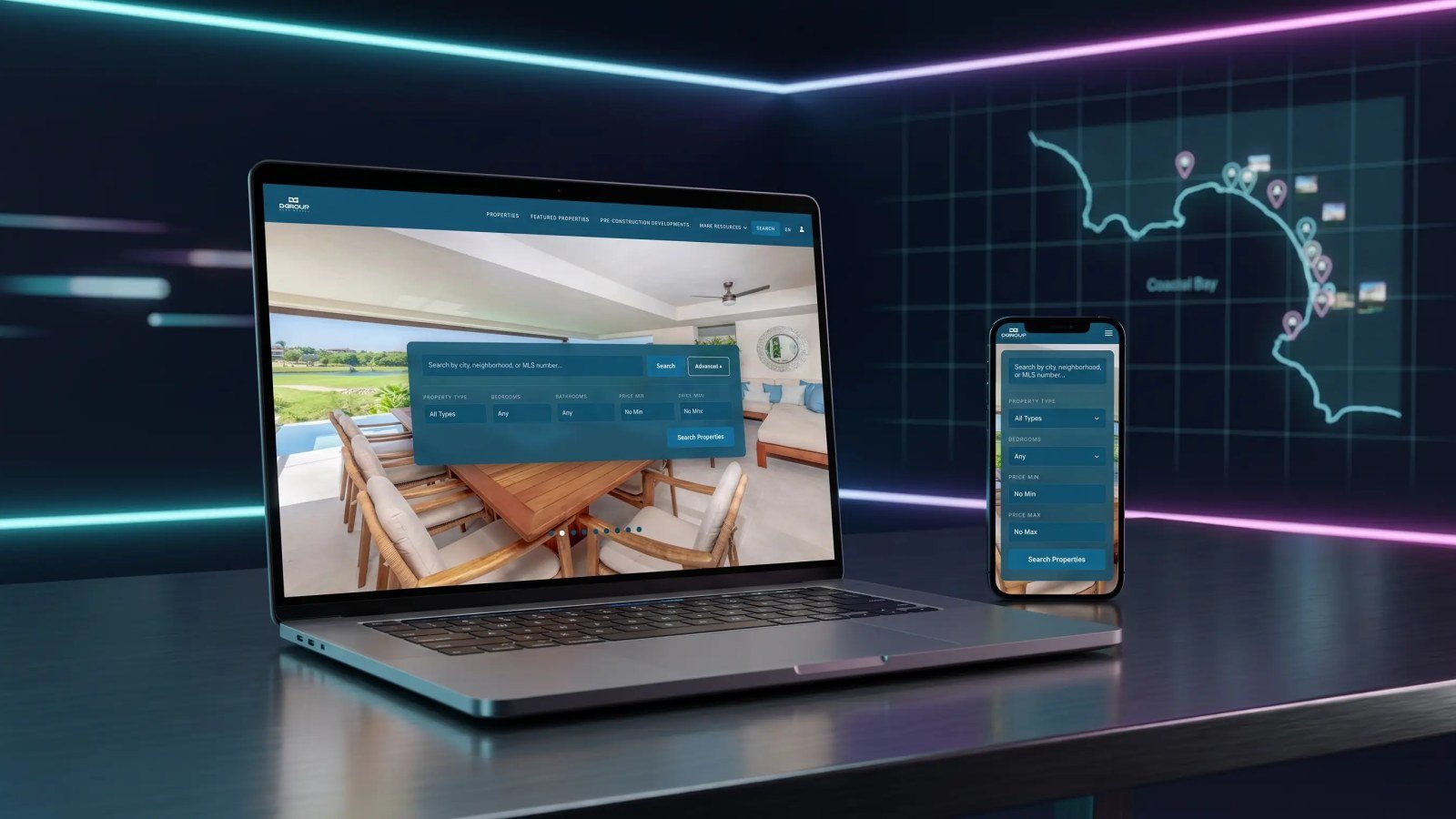
We connected D'Group Real Estate, a Puerto Vallarta brokerage, to Flexmls: synced inventory for the whole bay, search by MLS number and a pre-construction section independent from the MLS. We also run regional real estate portals that replicate the MLS into their own database and distribute that inventory to other sites, and OctoSync publishes properties via Flexmls.

Adapted to how you work
Every brokerage wants to show its inventory differently: only its own listings, the whole bay, featured pre-construction, a landing per development. We design the site around your sales strategy, not around a generic widget.
How we do it: we listen to your process, show you the proven base working, agree on what changes and launch in phases — with a first usable version early and improvements after.
Frequently asked questions
Do I need to be an MLS member to integrate Flexmls?
Yes. Data access is granted by the MLS to its members (or their authorized technology vendor). We help you with the request and the technical setup.
Will RETS stop working?
The industry is moving to the RESO Web API and RETS is being phased out gradually. If your site uses RETS, plan the switch; it can be done without rebuilding the site.
How often do listings update?
With the Web API, incremental changes can be pulled very frequently; with RETS, periodic syncs are scheduled. We tune it to your MLS rules.
Do listing pages rank on Google?
Yes, because each listing has its own URL, title, description and structured data, unlike iframe widgets that Google does not credit to your site.
Can I show developments that are not in the MLS?
Yes. Pre-construction and in-house projects live in a separate managed section next to the MLS inventory.
Other software we have built
Fast landing pages
One page, one goal, zero dead weight: landings that load instantly and turn an ad click into a conversation.
Inventory control system
Per-store stock, a ledger of every movement, low-stock alerts and sales that block when stock runs out.
Private transportation booking system
Quotes by zone and vehicle, bookings with online payment and a panel to run the day’s transfers.
Property management software
Owners, tenants, collections, maintenance and statements in one platform, with an owner portal.
Alarm maintenance software for security companies
Accounts, installed equipment, preventive maintenance and work orders with evidence for your technicians.
Land and lot sales software
Lots, reservations, installment sales, receipts, late interest and statements, plus a lot picker on your site.
Contact
Want this for your business?
Tell us how you work today. We reply the same day and, if it fits, show you the system running.
← All solutions · // coded with love & coffee